

Sex work legislation has multiple frameworks, and it can be difficult to get your head around what they all mean, what the differences are, and what their real-world impacts are. But don’t worry, we got you!
This page is here to help unpack the different legislative frameworks, and help you understand why decriminalisation is the gold standard!
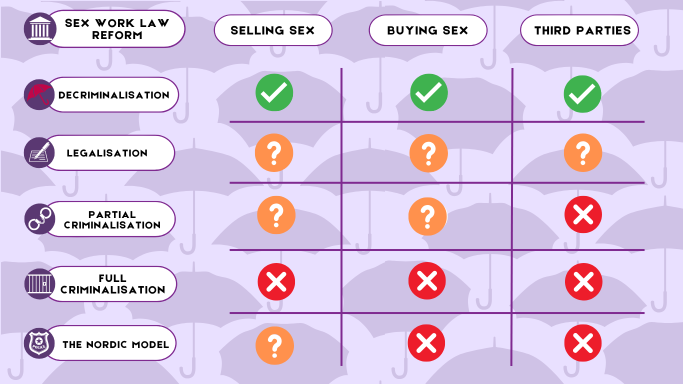
Types of Sex Work Law Reform
Decriminialisation
Decriminalisation is the gold standard for sex work law reform. It is the removal of all sex work-specific criminal laws that apply only to sex workers, our workplaces, clients, and third parties. It also removes police powers that unfairly target sex workers.
Under full decriminalisation, sex workers are subject to the same laws and regulations as other businesses. It helps to provide sex workers with the same legal protections as other workers.
Decriminalisation is the only model based upon human rights and supports the health, safety, and rights of ALL sex workers. It is often the most marginalised groups that are targeted and affected the most by criminalisation. Decriminalisation means rights for every sex worker, regardless of how or why we do sex work.
Globally, it is agreed that any criminalisation or legal oppression is detrimental to sex workers. Decriminalisation is regarded by Amnesty International, the World Health Organisation, Global Alliance Against Traffic in Women, and the United Nations as the best practice model for the health and safety of sex workers.
Most importantly, it is the model that is advocated for by sex workers.
Legalisation
Legalisation (sometimes referred to as Licensing) is a term that is often confused with decriminalisation. While decriminalisation refers to the removal or absence of criminal or other laws that oppress sex workers, legalisation is the introduction of discriminatory, harmful, and stigmatising laws that aim to impose state regulation and control sex work in ways that are overly restrictive in comparison to other industries.
Sex workers are subjected to limiting and extraordinary conditions under which the exchange of sexual services can take place; and sex work that occurs outside of these conditions remains criminalised.
State-sanctioned sex work legalisation frameworks are often oppressive and exclusionary in nature. These punitive and targeted legislation conditions can include local planning laws that restrict the number, location, and rules of operation for sex work businesses, public health laws that require mandatory individual registration (through a Govt regulated authority), compulsory STI testing of sex workers, or provisions that require licenses to operate within the industry.
This framework leads to a two-tiered system comprised of workers who can work within the legislation, and those who cannot. This can result in exploitative working conditions and human rights violations for those who are working illegally. Legalisation often impacts the most marginalised within our community.
Police are tasked with monitoring compliance under this legislation. Subsequently, sex workers and sex work establishments experience police surveillance and raids, with sex workers and businesses at risk of fines and/or prosecution.
Partial Criminalisation
Partial criminalisation is arguably the most ambiguous legislative framework relating to sex work. It is an umbrella term for the grey area between full criminalisation and legalisation.
The most common form of partial criminalisation is the legalisation of one specific type of sex work but the criminalisation of others. For example, brothel work may be legal but street-based sex work remains criminalised. This results in a two-tiered system where some workers are criminalised while others are not. Most often, this targets the most visible and vulnerable members of our community.
The use of administrative offences and public order laws against sex workers also commonly features under partial criminalisation. Administrative offences often deal with public order and security offences, some of which are sex work specific, while others are general offences that target sex workers, such as loitering, public indecency or public dress codes. Such offences can be used to oppress sex work businesses and sex workers by restricting our access to certain areas of a city, enforcing compulsory HIV/STI testing, or forcing us into rehabilitation.
Public order laws regulate the use of public space, impacting how and where sex workers and sex work businesses can operate. These laws can incorporate mandatory licensing for sex work businesses, including a requirement to publicly display licenses including full names. Zoning restrictions can include ‘prostitution-free’ zones and force sex workers into more isolated areas.
These laws impose strict controls on sex workers, negatively impacting our health and safety and increasing our risk of violence at work. This model creates harm for not only sex workers, but also our clients, families, partners and friends.
Full Criminalisation
Full criminalisation refers to a legislative framework of laws that make sex work, or activities associated with sex work, a crime.
These criminal laws are enforced by the police and other law enforcement agencies which result in the arrest, prosecution, and punishment, including imprisonment, of sex workers. Convictions can lead to criminal records, which can limit sex workers’ access to support services, housing, and employment, along with our rights to migrate, and even see or look after our children.
Full criminalisation results in sex workers having to operate in covert, isolated conditions, which results in a higher risk of extortion and violence. This is compounded by the fact that we often cannot turn to the police when crimes are committed against us, which effectively gives our perpetrators impunity.
Full criminalisation creates increased violence, stigma, exploitation, police repression, and reduced access to justice and services for sex workers.
South Australia is currently the only state with full criminalisation. Sex work was first criminalised under ‘vagrancy’ laws and then by criminal legislation such as the Summary Offences Act 1953 and the Criminal Law Consolidation Act 1935, which are still in force today. SA laws are the most punitive in Australia, defying current trends toward decriminalisation. There have been many attempts made to decriminalise sex work in SA, sadly none have been successful to date.
Nordic Model
The ‘Nordic Model’ refers to a type of legislation that seeks to shift the criminalisation of sex work from the sex industry service provider (sex worker) to the service user (client).
The Nordic model is also referred to as:
- The Swedish Model
- The End Demand Model
- The Equality/Entrapment Model
- Neo-abolitionism
- Partial decriminalisation
Nordic Model style legislation aims to eradicate sex work both in the short term, via criminalisation and fines for buying sex, and in the long term, by creating an understanding of sex work as inherently harmful to both the individual and society. It is based upon an ideological framework that regards all sex work as violence and all sex workers as victims that must be rescued from the sex industry.
The Nordic Model pushes the sex industry further underground, re-enforces barriers to accessing support and other services, and undermines harm reduction and safety strategies. The Nordic Model also retains Police as regulators of the sex industry. Studies* have shown a direct correlation between the Nordic Model and an increase in violence, the spread of STI’s, and exploitation in the sex industry.
This framework is infantilising to sex workers as it removes our agency, self-determination, and bargaining power. It is not rights based, nor does it speak to empowerment. The model positions ALL sex workers as victims of gendered and sexual violence, and ALL clients as perpetrators.
Peer-based sex worker organisations around the world, including Scarlet Alliance and NSWP, have spoken out against the Nordic Model. A growing number of international health and human rights agencies and experts, including Amnesty International, WHO, UN, and Human Rights Watch, have all concluded that criminalising any aspect of sex work threatens sex workers’ health, safety and rights.
*Global Network of Sex Work Projects, 2015, ‘The Real Impact of the Swedish Model on Sex Workers Advocacy Toolkit.’
Amnesty International, 2016, ‘The human cost of ‘crushing’ the market: criminalization of sex work in Norway.’